

While commercial and residential lifts both facilitate vertical movement, they are engineered for vastly different environments and demands. Commercial lifts are high-capacity, high-speed “workhorses” designed for heavy traffic and strict regulatory compliance in public spaces.
In contrast, residential lifts prioritise comfort, aesthetics, and compact design, offering homeowners a customisable and space-efficient solution for accessibility. Understanding these key distinctions in usage, structural requirements, and safety regulations is essential for choosing the right system for your property.
Purpose and Usage of Lifts
Commercial Lifts
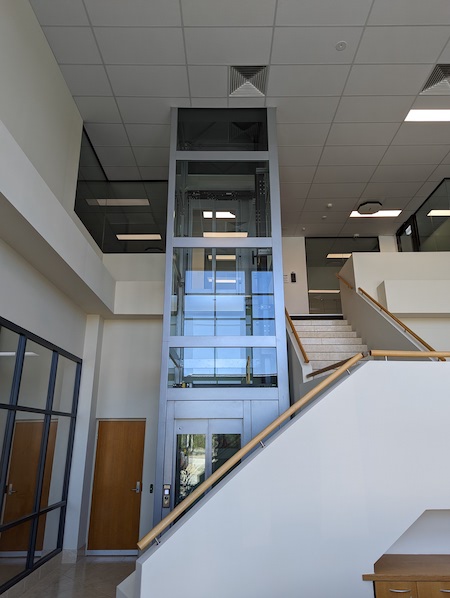
Commercial lifts are the workhorses. They’re engineered specifically for high-traffic environments, often eight to twenty people or more, where reliability under constant use is non-negotiable. They are popular in office towers, hospitals, hotels, retail complexes, and apartment buildings, where they might make hundreds of trips daily.
Commercial lifts can also be used to transport goods, equipment, or even vehicles. Speed, reliability and durability are paramount. These lifts need to move quickly during peak periods whilst withstanding the wear and tear of continuous operation year after year.
Residential Lifts
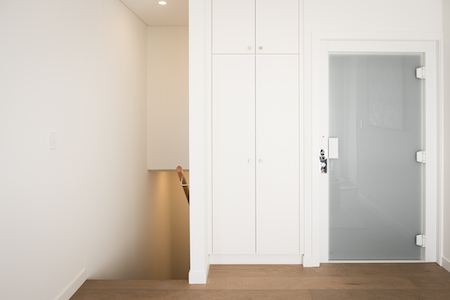
Residential lifts are intended for low-frequency, personal use within private homes. Rather than prioritising capacity and speed, residential lifts focus on comfort, accessibility, convenience, and of course, aesthetically integrating with your home’s interior design.
A typical home lift carries between two and five passengers at slower, gentler speeds for a smooth, quiet ride. They’re about enhancing your quality of life, especially for elderly family members, to navigate multiple storeys, accommodating mobility challenges, or simply adding a premium feature that adds function and value to your home.
Also read: 5 Reasons Why You Need a Residential Lift in Your Home
Key Distinctions
The fundamental differences come down to:
Traffic volume: Commercial lifts handle dozens or hundreds of trips daily; residential lifts might make only a handful.
Capacity and weight limits: Commercial models typically support 630kg to well over 1,000kg, whilst residential lifts often range from 250kg to 400kg.
Ride performance: Commercial lifts operate at higher speeds (up to 1 metre per second or more) with rapid door cycles; residential lifts move more slowly (around 0.3 to 0.6 metres per second) with a focus on smooth acceleration and deceleration.
Functional versus aesthetic priorities: Commercial installations emphasise efficiency and compliance; residential installations balance functionality with design harmony.
Design, Engineering, and Customisation
Commercial Lifts
From an engineering perspective, commercial lifts are built to handle heavy loads and continuous operation without compromise. They’re designed with robust mechanical systems, reinforced cabins, and components designed for longevity under demanding conditions. The structural requirements mean these lifts often need dedicated machine rooms, deep pits, and significant overhead clearance.
Aesthetically, commercial lifts lean towards functional and standardised appearances, although high-end commercial buildings, like premium hotels, boutique department stores or offices, may feature premium finishes. The focus remains on durability, ease of maintenance, and meeting accessibility standards rather than creating a bespoke look.
Residential Lifts
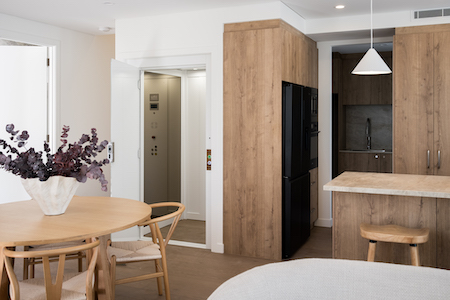
Residential lifts are completely customisable. Their systems are highly adaptable to suit your home’s interior design, whether that’s contemporary minimalism, classic elegance, or something uniquely your own. You’ll find a wide variety of options for cabin finishes, from timber veneers and glass panels to custom lighting schemes and designer handrails.
Door styles can be tailored to complement your home’s architecture, and the entire lift can be designed for exceptionally quiet operation, ensuring it doesn’t disrupt the peaceful atmosphere of your living areas. Modern residential lifts can be remarkably compact, with some models requiring minimal pit depth or even operating without a traditional lift shaft.
Key Distinctions
Structural requirements: Commercial lifts demand substantial building modifications; residential lifts can often be retrofitted with minimal structural intervention.
Customisation flexibility: Residential lifts offer extensive personalisation options; commercial lifts work within more standardised parameters.
Material selection: Home lifts can incorporate premium residential materials that might not withstand commercial use; commercial lifts use industrial-grade components throughout.
Space and shaft configuration: Residential lifts are designed to fit within existing homes with creative space-saving solutions; commercial lifts require purpose-built shafts with specific dimensions.
Regulations, Safety Standards, and Installation
Commercial Lifts
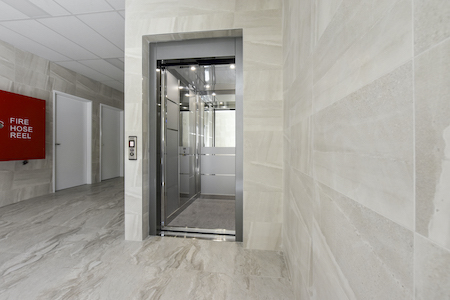
In Australia, commercial lifts must meet strict Australian building codes and accessibility legislation. These regulations ensure that lifts in public and commercial buildings are safe, accessible to people with disabilities, and capable of handling emergencies. Compliance isn’t optional; it’s mandatory.
Commercial lifts require regular and more frequent inspections and maintenance schedules, often mandated by law. They must include comprehensive safety features such as emergency communication systems, backup power supplies, fire-rated construction, and multiple redundant safety mechanisms. The installation process is complex, typically requiring coordination with building certifiers, engineers, and local authorities.
Residential Lifts
Residential lifts follow standards appropriate for private dwellings, which, whilst still rigorous, offer more flexibility in design and installation. The regulatory framework recognises that home lifts serve a different purpose and operate in a controlled, private environment.
This doesn’t mean residential lifts compromise on safety; they still incorporate essential features like emergency stop buttons, backup lowering systems, and door interlocks. However, there’s greater flexibility in how these features are implemented and what additional options are considered mandatory versus optional.
Maintenance requirements are typically less frequent than commercial installations, reflecting the lower usage. Installation can often be completed more quickly and with less disruption to your home, particularly with modern residential lift systems designed specifically for retrofit applications.
Key Distinctions
Compliance obligations: Commercial lifts navigate complex regulatory frameworks with strict enforcement; residential lifts work within more flexible standards suited to private use.
Mandatory versus optional features: Commercial installations must include numerous accessibility and safety features by law; residential lifts offer more choice in feature selection based on individual needs.
Installation complexity: Commercial projects involve extensive coordination, permits, and inspections; residential installations are typically more straightforward with faster approval processes.
Cost implications driven by regulation: The stringent requirements for commercial lifts significantly impact both initial installation costs and ongoing maintenance expenses; residential lifts benefit from more cost-effective compliance pathways.
At a Glance: Commercial vs. Residential Lifts |
||
| Feature | Commercial Lifts | Residential Lifts |
| Purpose | Efficiency, durability, and high volume. | Comfort, style, and accessibility. |
| Capacity | 630kg to 1,000kg+ (8–20+ people). | 250kg to 400kg (2–5 people). |
| Speed | Fast (up to 1m/s) with rapid door cycles. | Gentle (0.3–0.6m/s) for a quiet ride. |
| Engineering | Heavy-duty; requires deep pits and machine rooms. | Compact; often requires minimal structural changes. |
| Regulation | Strict building codes and mandatory frequent inspections. | Flexible standards tailored for private dwellings. |
Need To Choose an Elevator for Your Next Project?
At Platinum Elevators, we understand that every project is unique. Whether you’re developing a commercial property that requires robust, compliant lift solutions or you’re a homeowner looking to add convenience and value to your residence, our team brings the expertise and local knowledge to deliver exceptional results.
Contact us today for a free consultation. We’ll work with you to understand your specific requirements and show you how we can seamlessly integrate the perfect lift solution into your project, residential or commercial. Call us on 1300 000 260 or email info@platinumelevators.com.au to get started.